• about
  • journal
  • store
Menu

archaic studio

Street Address
City, State, Zip
Phone Number

Your Custom Text Here

archaic studio

  • about
  • journal
  • store

Cisterne // Hiroshi Sambuichi

April 1, 2019 archaic
archaic_HiroshiSambuichi_Cisterne_2.jpg

Architects: Hiroshi Sambuichi

Location: Copenhagen, Denmark

Year: 2017

Photographs: Rasmus Hjortshøj
archaic_HiroshiSambuichi_Cisterne_4.jpg
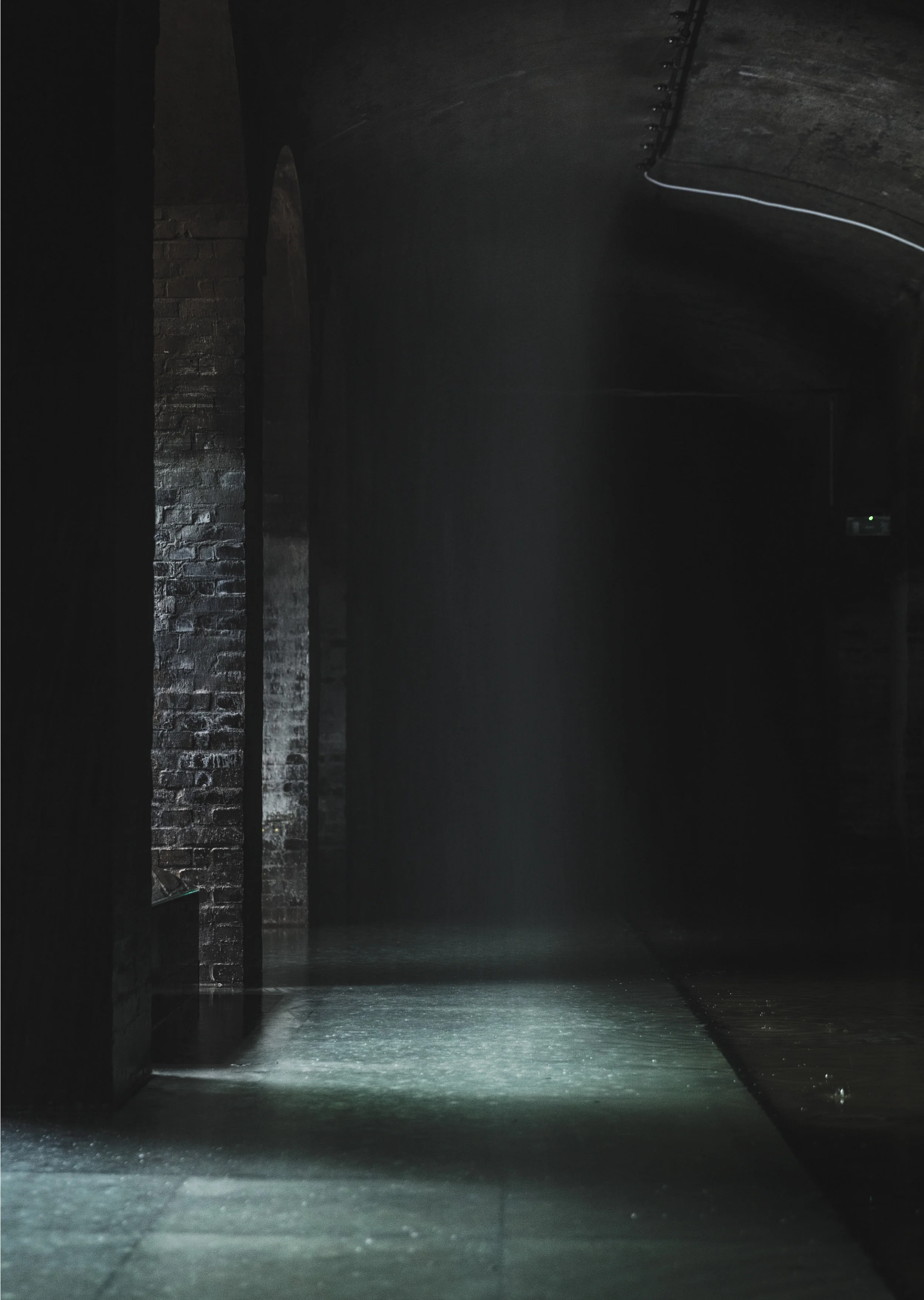
Travel through an enchanting sea of light and darkness orchestrated by the praised Japanese architect Hiroshi Sambuichi. He here shares his thoughts behind the wondrous water and light installation set in an old underground water reservoir. “What interests me the most is to bring out the beauty of the place.” Sambuichi always considers “the moving materials” at a specific site, and in particular the sun, the water and the air. To truly know a place, one has to experience it during the four seasons – spring, summer, autumn and winter – as these moving materials change accordingly: “The way these materials move will be thoroughly investigated and will be united to represent what was originally there.” In continuation of this, it was important for Sambuichi to keep in mind the history “behind this subterranean space”, which dates back to the 1800s. For the shrine-like installation, Sambuichi designed a top-light so the sun could enter, as well as a 120-meter long corridor that led to the room where sun and water meet: “I wanted to join the sun with the water in here. For 150 years the water here had not met the sun.” Moreover, the Japanese architect has added mirrors as a central part of the exhibition to bring the sun underground and uses a ‘camera obscura’ to reflect Frederiksberg Palace – which the site-specific installation pays tribute to – down into the cisterns. In this way, Sambuichi – according to himself – enhances the beauty of the place. “It is important to understand that water can become lighter than air. If people understand that, they will understand the relation between human beings and the earth… And when thinking about that, they will see a rainbow and if not, they will see how the light and the heat from the sun will make the water change form to gas, solid state and liquid.” The CO2 level in the Cisterns is five to ten times as high as outside in nature, and Sambuichi wants to show the relation between carbon dioxide, people and plants. We are all a part of a cycle – “people are not at the top of the pyramid” – and balance is of utmost importance: “The relation between islands, water, sun and plants is something very important for me. And because we have the sun and water here the Cisterns have an expression which is a perfect fit for me.” Hiroshi Sambuichi (b.1968) is a Japanese architect, who is considered one of the top experimentalists of sustainable architecture, creating a symbiosis between nature and architecture. Built upon both personal intuition and scientific investigations, his architecture attains a rare balance between poetics and science. In 2001 Sambuichi established Sambuichi Architects. He is currently an Honorary Professor at the Royal Danish Academy of Fine Arts, School of Architecture. In 2017 he was awarded the Wallpaper* Design Award for Naoshima Hall. Hiroshi Sambuichi was interviewed by Christian Lund in connection with his installation ‘The Water’ at the Cisterns in Copenhagen, Denmark in March 2017. In ‘The Water’ (on show March 2017 – February 2018), natural daylight interacts with the water and consequently, the opening hours of the installation vary with the length of day, closing at sunset. When crossing the underground sea, the visitor will walk on an interpretation of the Japanese Itsukushima Shrine on the Japanese island of Miyajima. ‘The Water’ is Sambuichi’s first major exhibition outside Japan. For more see: http://www.cisternerne.dk/en/what-s-on/exhibition/current.html Translator: Alex Hummel Lee, project leader & partner, Sambuichi Architects Camera: Klaus Elmer and Jacob Solbakken Edited by: Klaus Elmer Produced by: Christian Lund Copyright: Louisiana Channel, Louisiana Museum of Modern Art, 2017 Supported by Dreyers Fond
archaic_HiroshiSambuichi_Cisterne_23.jpg
archaic_HiroshiSambuichi_Cisterne_5.jpg
archaic_HiroshiSambuichi_Cisterne_6.jpg
archaic_HiroshiSambuichi_Cisterne_13.jpg
archaic_HiroshiSambuichi_Cisterne_3.jpg
archaic_HiroshiSambuichi_Cisterne_8.jpg
archaic_HiroshiSambuichi_Cisterne_26.jpg
archaic_HiroshiSambuichi_Cisterne_27.jpg
archaic_HiroshiSambuichi_Cisterne_28.jpg
archaic_HiroshiSambuichi_Cisterne_24.jpg
In 2010s, installation Tags Hiroshi Sambuichi, Rasmus Hjortshøj
← Four Boxes Gallery // atelier bow wowSix Vaults Pavilion // Gijs Van Vaerenbergh →
No results found

buy our publication: image [im-ij] \ ˈim-ij

image
[im-ij] \ ˈim-ij \ image
[im-ij] \ ˈim-ij \
image [im-ij] \ ˈim-ij \
€27.00

"An image is not only a representation — it is a tool, a vision, and a reflection of the way we think about space."

From the visionary drawings of Antonio Sant’Elia to the radical concepts of Cedric Price, architectural imagery has shaped how generations perceive and communicate design.
In image, architect and curator Anja Dotter explores the power of the image as a creative and intellectual instrument in contemporary architectural practice.

Through a series of interviews with emerging European architects, photographers, and visualization studios, this book unveils how the architectural image is produced, shared, and interpreted in a digital age where visual communication defines cultural identity.

Both analytical and visually engaging, image offers insight into the creative processes behind architectural photography, digital rendering, and conceptual visualization. It invites readers to reflect on the ongoing dialogue between architecture and its representation — between idea and perception.

Ideal for architects, designers, photographers, and creative thinkers, image captures the pulse of a new generation shaping how architecture is seen, imagined, and remembered.


follow us

hello@archaic-studio.com


archaic_studio

@__marcodistefano 🤍 #archaicstudio
@genevievelutkin 🤍 #archaicstudio
@wingardhs 🤍 #archaicstudio
@tallerhectorbarroso 🤍 photo by @cesarbejarstudio #archaicstudio
via @acanthusmagazine 🤍#archaicstudio
@borsanimaginaria 🤍 #archaicstudio
@nicolas_db 💚 #archaicstudio
@stellabirda 💙 #archaicstudio
@christopheguye 💙 #archaicstudio
@leonie.marrakech 💓 #archaicstudio

Newsletter

Thank you!
 

selected

Featured
archaicstudio_Aarau_GLSARCH_12.jpg
Nov 25, 2024
House in Aarau // Gautschi Lenzin Schenker
Nov 25, 2024
Nov 25, 2024
archaicstudio_flyingdoric_5.png
Nov 7, 2024
Flying Doric // Nuno Reis Pereira
Nov 7, 2024
Nov 7, 2024
archaicstudio_HaduwaStage_5.jpg
Oct 22, 2020
Haduwa Stage // IoA Institute of Architecture
Oct 22, 2020
Oct 22, 2020
archaic_Hildebrand_Blausee_3.jpg
Mar 12, 2020
Wasserhaus // Hildebrand
Mar 12, 2020
Mar 12, 2020
archaic_AvantoArchitects_20.jpg
Dec 19, 2019
Kyrö Barrell Storage Building // Avanto Architects
Dec 19, 2019
Dec 19, 2019

categories


+ art

+ classics

+ competition

+ conceptual

+ decades

   1890s

   1920s

   1930s

   1940s

   1950s

   1960s

   1970s

   1980s

   1990s

   2000s

   2010s

2020s

+ demolished

+ design

+ design build

+ exhibition

+ fashion

+ film

+ furniture

+ geometry

+ green

+ installation

+ interior

+ landscape

+ low budget

+ photography

+ student work


typology


bridge

cemetery

chapel

church

cinema

crematorium

cultural center

extension

factory

gallery

hangar

hostel

hotel

house

housing

kindergarden

library

monument

museum

office

parking

pavilion

ranch

reconstruction

restoration

retail

school

shop

sport

studio

swimming pool

terminal

tower

university


material


aluminium

brick

concrete

marble

metal

mud

steel

stone

wood